
The 1940s Wartime Dessert That Still Looks Like Magic: Icebox Cake
Some recipes survive not because they're complicated, but because they're almost impossibly clever. The 1940s Icebox Cake is one of those recipes. Made during a time when butter and eggs were rationed and every ingredient counted, this two-ingredient dessert somehow produces something that looks like it took hours. It didn't. And once you understand why it works, you'll never forget it.
BLOG CLARA'S KITCHEN
KimB
6/13/20264 min read
What Is an Icebox Cake?
Before every kitchen had a refrigerator, there was the icebox — a wooden cabinet cooled by a large block of ice delivered to your door each week. It kept things cold, but not for long, and not reliably. Women learned to work with what they had, and what they had was a box of cold air and a little bit of ingenuity.
The icebox cake was born from exactly that kind of thinking. No oven, no eggs, no flour — just layers of whipped cream and cookies stacked together and left to rest overnight. It sounds almost too simple to amount to anything. But that's the magic of it.
By the 1940s, when butter and eggs were rationed and every ingredient had to stretch as far as it could go, the icebox cake became a quiet staple in American kitchens. Women made it for dinner parties, for Sunday company, for summer evenings when turning on the oven felt like a small act of defeat. It was elegant without being expensive, impressive without being difficult, and it asked almost nothing of the woman who made it — except a little patience.
The Science of the Overnight Magic
Here is what happens when you put an icebox cake in the refrigerator and walk away.
The whipped cream you spread between each cookie is full of moisture. Overnight, the cookies — dry and firm when you first stacked them — slowly absorb that moisture from every direction. The cream seeps in. The cookies soften. And by morning, what was once a row of hard chocolate wafers has transformed into something that slices like a perfectly layered cake.
There is no baking. No heat. No chemistry you have to manage or watch. You simply have to leave it alone and let time do what time does.
The result is one of those rare kitchen moments where the effort you put in and the result you get out feel genuinely mismatched — in the most satisfying way possible. You stacked some cookies. You went to bed. And in the morning, there is a cake.
The Diagonal Slice Reveal
This is the part that women in the 1940s knew, which we seem to have forgotten.
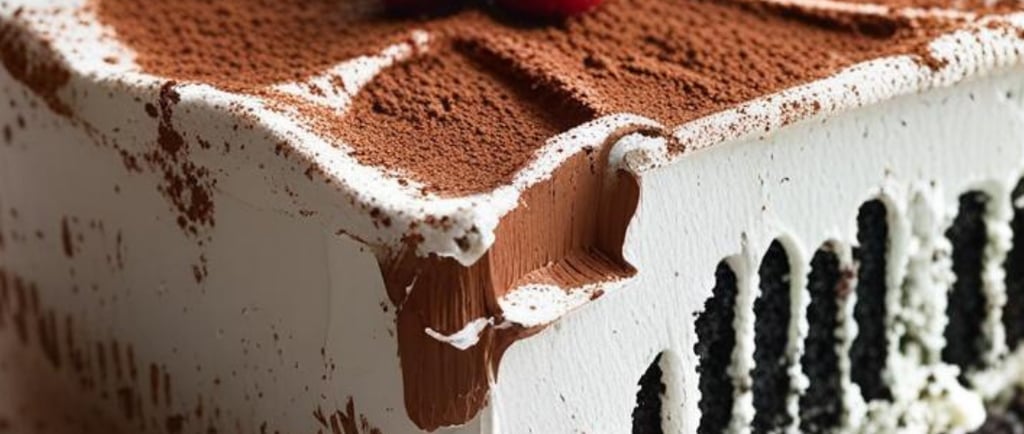
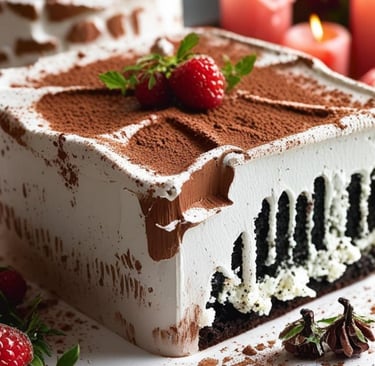
You don't slice an icebox cake straight down. You slice it on the diagonal — at an angle, running from one corner to the other. And when you do, the entire striped interior of the cake comes into view at once. Chocolate and cream, chocolate and cream, running in perfect layers all the way through.
Picture a quiet morning kitchen. The cake has been in the refrigerator overnight. You lift it out, set it on the counter, and pick up your knife. One slow diagonal cut, and there they are — those stripes, clean and exact, as if you'd spent hours coaxing them into place.
You didn't. That's the whole point.
The diagonal slice is the reveal. It's the moment the icebox cake shows you what it quietly became while you were sleeping.
How Women in the 1940s Served It
During wartime rationing, the women who kept homes running had to become experts in a particular kind of grace — the grace of doing a great deal with very little, and making it look effortless.
The icebox cake was part of that. On hot summer evenings, when the last thing anyone wanted was an oven running for an hour, this dessert appeared on tables looking like it had taken all afternoon. It hadn't. For company, women would arrange it on their best oval platter, dust the top with cocoa powder, and set it out as if it were the most natural thing in the world.
Zero waste. Maximum elegance. That phrase sounds modern, but the women of the 1940s were practicing it out of necessity long before it became a philosophy. They couldn't afford to be wasteful, so they learned to be creative. And the icebox cake is one of the most beautiful things that creativity ever produced.
The Recipe
Ingredients:
2 cups heavy whipping cream · 3 tablespoons powdered sugar · 1 teaspoon vanilla extract · 1 pinch of salt · 9 oz chocolate wafer cookies (Nabisco Famous Wafers are traditional)
To make it:
Start by whipping the heavy cream with the powdered sugar, vanilla, and salt until it holds stiff peaks. Take your time here — properly whipped cream is what makes the overnight transformation work.
Spread a layer of whipped cream on each chocolate wafer and stack them into a log directly on your serving platter, working in small stacks of four or five and pressing them end-to-end into one long log. Use the remaining cream to cover the outside completely — top, sides, and ends. It doesn't have to be perfect. Rustic looks beautiful.
Cover it loosely and refrigerate for at least eight hours, or overnight.
The next morning, slice diagonally and serve.
For a dressed-up version: tuck a layer of fresh raspberries or sliced strawberries between every few cookies as you stack. The berries soften overnight right along with the cream, and the colors running through the stripes make it look like something from a bakery window.
Why This Recipe Still Matters
There is a kind of wisdom that only comes from constraint.
The women who made icebox cakes in the 1940s weren't working from an abundance of options. They were working from what they had — a few ingredients, a cold box, and the patience to let something sit overnight and become what it needed to become. And what they produced, again and again, was beauty.
That is the quiet lesson at the heart of this recipe, and at the heart of so much of what homemaking has always been. You don't need more to make something meaningful. You need intention. You need a little time. And you need the willingness to trust that something good is happening even when you can't see it yet.
That's what we're after here at Homemaking Through the Decades — not a perfectly curated home or a flawlessly executed recipe, but a life that feels calm and warm and full. A home that feels like somewhere you actually want to be.
This cake is a small, sweet reminder that those things have never required as much as we think they do.